Hello World :)

Welcome to Raquel N' Roll!

A person once told me that if I have to explain the joke, the joke is in fact, not funny. As an extremely humorous person, a person who laug...

Thursday, June 23, 2022

5 Things I Learned Working in the Ocean/Climate Space:


Living in Palau, I had the opportunity to develop the communications strategy for the Our Ocean Conference, an annual global conference dedicated to bringing governments, industry leaders, civil society, and more to commit to safeguarding our ocean. I had always identified as a climate advocate, but I learned just about a lifetime of knowledge from working within the marine conservation communications space. This made me realize that if I didn’t know this much, what else does everyone not know?

I had to “get smart quick” on marine and environmental conservation to develop a global communications strategy from Palau’s perspective. This post highlights five key takeaways from immersing myself in the ocean and climate justice space. 

I will touch upon the following:

  1. The Ocean is Absolutely Related to Climate Change
  2. Island Nations (Like Palau) Rely on the Ocean
  3. The Ocean is Out of Sight, Out of Mind
  4. The Ocean is Only About 80% Discovered
  5. Corals Are Very Much Alive - and Not Thriving


1. The Ocean is Absolutely Related to Climate Change


What do you think of when you hear the phrase climate change? Do you think of changes in temperature or changes in weather patterns? Or maybe, you think of the “melting ice is causing sea levels to rise” narrative? Whichever topics or phrases come to mind, do they ever include the ocean? For an easy-to-read breakdown of climate change and its effects on our lives, check out this post by the United Nations.

I had no marine science knowledge, but I did understand that burning fossil fuels (such as oil, coal, and gas) are causing global temperatures to shift. And this has been slowly happening since the Industrial Revolution (the early 1800s). The Our Ocean Conference seeks to shift the narrative about climate change and focus more on how the ocean is a solution to climate change.

So do these gases just sit in the atmosphere? Not quite. The ocean actually absorbs the trapped gas and additional heat. The International Union for Conservation of Nature (IUCN) has an excellent brief explaining why the ocean is disproportionately affected by climate change. The brief explains that the ocean is essential in regulating the Earth’s climate. IUCN also cites scientific studies on ocean warming and dives deeper into the catastrophic effects on the ocean, marine life, and human vulnerabilities.


2. Island Nations (Like Palau) Rely on the Ocean


In Palau, the ocean is life. Because islanders rely on the ocean for sustenance, climate change is not only changing temperatures throughout the world but is actively attacking a way of life. Living in Palau, I’d see folks fishing nearby or hear folks talk about the fish they caught over the weekend. I was spoiled at the local fishery because I could purchase freshly caught fish (hello, red snapper!) and have it cleaned, filleted, and ready for cooking.

Palauans and other islanders rely on the ocean for food. Sure, other food sources are available, but the ocean provides a plethora of fish for frying, smoking, or storytelling. Food scarcity increases if the ocean is warming, causing species migration patterns to change or causing ecosystems to die off. In addition to decreased resources, rising tides, and bad weather, climate change can cause millions of dollars in damage and ultimately displace people from their homes. In April 2021, Typhoon Surigae struck Palau and caused devastating damage. Palau had not experienced such a powerful typhoon since 2013.

In addition to how the ocean provides livelihoods, Palauans are also deeply connected to the ocean. There is a Palauan legend that states Palauans came from the ocean. Throughout Palauan folklore, the ocean is almost always included in the stories from a giant named Uab (pronounced oo-wab) who fell into the ocean creating Palau, or the woman who jumped into the sea and became a dugong. These stories highlight how the ocean is centered around island life. It is stressful for vulnerable island populations and communities to fathom a life without being able to connect to your livelihood, especially when your livelihood is constantly and more consistently under threat.


3. The Ocean is Out of Sight, Out of Mind


I saw the ocean every single day in Palau. When I drove to work, I would see the ocean. After work and on the weekends, I would swim in the ocean. My home in Palau was minutes away from the ocean. In Palau, the ocean became an integrated part of my daily life because it was readily available. During my research phase, where I learned that climate change is exhausting the ocean, I remember thinking, “Why don’t more people care about this?” My follow-up realization was, “Ahh. Geography.”

Your lifestyle is an extension of how and where you were raised. I grew up in La Habra, CA, a city roughly 20 miles (about an hour’s drive) inland from the pacific ocean. I then lived in Washington, DC, roughly 120 miles (about a two-hour drive) inland from Ocean City, MD, a popular beach city to relax and unwind. Living in American cities, you are constantly barraged with capitalism and consumerism where trivial things like from which franchise should I purchase my morning cup of coffee become a part of your daily routine.

There isn’t a huge concern about rising tides infiltrating one’s home in landlocked states. Instead, we are concerned about saving electricity, saving water, and recycling (I’m looking at you, California). While these actions contribute to resource management and environmental conservation efforts, they leave out the ocean. Americans simply don’t think about marine conservation because the country is landlocked, except for the west and east coast, which includes 20 out of 50 states, not including territories like Guam.

Is this selfishness? Yes, in part. Many people couldn’t point out Palau on a map if their lives depended on it. It is human nature to not think about what we don’t see (the very reason I hide ice cream in the back of the freezer). Island nations like Palau are taking the brunt of climate change due to more affluent countries’ actions. Check out this Time article by Palau President Surangel S. Whipps, Jr. shedding light on how richer countries should be held accountable for the climate crisis.


4. The Ocean is Only About 80% Discovered


Since grade school, we were taught that the ocean covers around 70% of the earth's surface, but did we ever honestly think about it? I believe this must be repeated throughout ocean conservation’s social platforms. Again, the places I’ve lived did not empower me to learn more about oceans, but in Palau, I’ve seen some of the weirdest, coolest, and prettiest marine life I never knew existed.

I learned that the ocean is still not fully discovered and mapped, which means there are unknown species, ecosystems, and more. According to National Geographic, roughly 80% of the ocean has never been explored because our technology doesn’t allow us to dive too deep. I had the opportunity to talk with folks from the Palau International Coral Reef Center (PICRC), a non-profit dedicated to local and national marine research and conservation. PICRC has technology for deep water research and shared underwater footage of creatures at 620 meters deep (just over 2000 feet). It is unclear how long the camera remained at this depth, but this location captured footage of a Chaceon crab and provides invaluable insight into marine life and behavior.

It is astonishing to think that undiscovered creatures within the ocean are suffering or no longer exist. If we knew more about the ocean and the species living within, we might be better equipped to understand and end the ocean climate crisis. Because there are several unknowns about the ocean floor, geography, marine life, ecosystems, and more, it is crucial to invest in ocean science and technology like cameras and scuba gear that can withstand water pressure several thousand meters deep.


5. Corals Are Very Much Alive - and Not Thriving


When I first visited a nearby beach in Palau, I immediately noticed grey, crusty-looking rocks that seemed to wash up in bulk with the tides. Some were sharp, and most were tubular in shape. I remember thinking, “why is the beach covered in this?” I later found out that I was stepping on a graveyard of corals. Due to climate change, the world’s coral reefs are under threat of completely disappearing.

In the past 50 years, coral bleaching has been a growing cause of death to the world’s most vibrant coral reefs. Corals are actually classified as animals and share a symbiotic relationship with algae. When coral is stressed, algae is expelled, resulting in starvation. Stressors include significant environmental changes caused by climate change, such as heat, pollution, or too much direct sunlight. Not all bleached coral is dead, but prolonged stress and starvation lead to death. The World Wildlife Fund shares the basics of coral bleaching in this article.


Coral bleaching isn't just about protecting coral reefs - it’s about protecting vulnerable populations’ livelihoods. Corals are essential to reefs because of their role in multiple ocean ecosystems. They provide homes and shelters to reef fish, shrimp, turtles, jellyfish, sea stars, and more. These animals may face mass extinction if corals continue to die at an alarming rate. In a study performed between 2014 and 2017 by the National Oceanic and Atmospheric Association (NOAH), it was discovered that 75% of the world’s coral reefs experienced heat stress.


Summary


Before my employment, I thought corals were plants and mainly ornamental. I also thought climate change only affected the weather and temperature. Now, I fully understand the importance of coral’s role within the ocean and climate change through islander perspectives. I am probably one of only eight people in America who can point to Palau on the map, and I am proud of that. I take Palau with me everywhere I go because I am more knowledgeable about marine conservation, marine protected areas, marine pollution, and, frankly, the underreported threats of climate change on humanity.

Thank you, Palau.

With love,
Raquel

Wednesday, May 18, 2022

A Visit To Peleliu

This is Orange Beach, the first American invasion site, which started the 73-day-long battle.

My partner and I headed to Peleliu for a quick weekend getaway. Knowing that Peleliu was home to some of the bloodiest battles in WWII, we elected to do a land tour. Our guide escorted us throughout Peleliu and essentially took us back in time.


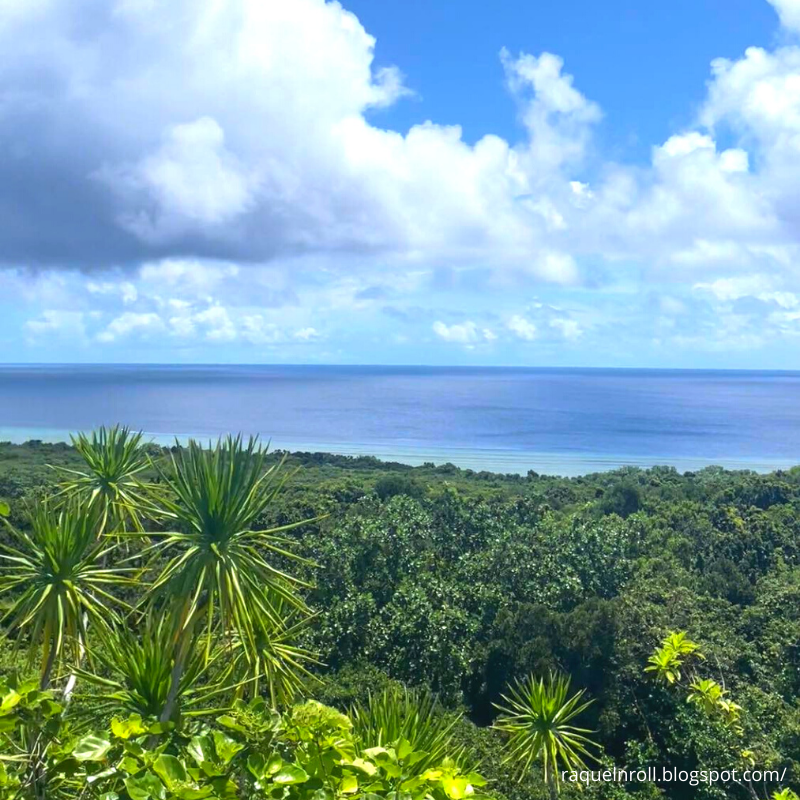
View from Peleliu's highest point.
The island of Peleliu lies southwest of Palau's main island of Babeldaob. Peleliu used to be home to over a thousand people - until WWII came. Today, the island is populated by roughly 300 people as more families and youth move northeast to the big island. The island is traversed weekly by locals who may have family in Peleliu or by the savvy diver seeking adventure in the nearby reefs. Peleliu offers shipwreck dives and the famous Drop Off and Blue Corner dive sites for the diver. About 3-4 hotel locations are all conveniently located five minutes from the north dock.


War in Peleliu

 
The war devastated Peleliu. The war destroyed the natural environment and ancestral locations, and it also displaced people. By 1944, more than 11,000 Japanese soldiers occupied Peleliu. The island was an exceptional point of interest to the Japanese because they had already lost the Marianas, Solomons, and the Marshall Islands. They shaped Peleliu into a fort by carving caves out of the island's natural limestone, forcing the Americans to push forward into its defenses. The 73-day-long battle ended when a Japanese Imperial Army Colonel performed ritual suicide signifying defeat. 

Peleliu Today


Helmets with bullet holes.  
Remnants of the war are scattered almost everywhere. The island, spanning more than 5 square miles, exhibits tanks, howitzer guns, bullet casings, bullet-stricken helmets, bullet-stricken canteens, caves, and previously Japanese-occupied buildings. Over the past 70 years, the jungle's dense foliage has quickly buried then-obvious locations such as a Japanese communications building, American beachside camps, and entrances to caves, which the Japanese had built to hold Peleliu against American forces. 

A tank in the middle of the road.


It is astonishing to see old island photos depicting a barren wasteland with absolutely no trees. Aiding the bombardment of the land, flamethrowers were a common tactic to drive out opposing forces who hid within the caves during the battle. Due to the growth and towering trees, you cannot see past 10 feet in front of you. It is quite easy to become lost if you don't know your way. If we didn't have a guide to escort us, we would have missed the locations of tanks, bunkers, and communications buildings entirely.


The remains of a Japanese communications building.

Pictured to the right is a photo of the inside of a Japanese communications building. This building was huge. Upon entering the two-story building, your imagination brings you back in time. This building is in multiple old aerial shots from the war. Now overtaken by the jungle, this building offers shelter to the numerous fruit bats and other native creatures. 


An armored door, still intact.


The picture to the left shows an armored door, fully intact, which leads to an additional area for unlimited use. The second floor of this building has decayed, and only a staircase remains to indicate there was indeed a second floor. Outside this building, a couple of hangars were once used for mechanical repairs; only a few tools and/or cans are left. 


The Experience


While the Peleliu Land Tour offered many amazing sights and history, the experience that stood out to me was what is pictured below. This is an entrance to a Japanese air-raid bunker. Conveniently, this bunker is positioned right outside the building from the pictures above. If the Japanese troops heard that opposing forces were attacking from the air, soldiers would rush into the bunker for safety.

Entrance to a Japanese air raid bunker.

"You can go inside if you want," our tour guide beamed. 


Knowing that I would probably never have a chance to explore an untouched world war two relic, I obliged. I only made it down the steps to look inside, but this experience stood out because I could feel an icy and still presence as if the uncertainty of the soldiers' lives lingered in the air. My partner and the guide were merely ten feet away, but time seemed to stop down here. I endured only a few more minutes which felt like hours, and I rallied myself back up the stairs to the group. I'm not one for real-life ghost stories, but I think it was wise to leave this place undisturbed.

Ironically, it wasn't just this bunker where I felt a similar eerie feeling. I entered a couple of caves where 1000 men died within and where Japanese Colonel Nakagawa committed ritual suicide. The only scary things I saw were crickets the size of my big toe and upset fruit bats because we were obviously disturbing their peace. Of course, there were plenty of Sapporo beer bottles and even artillery left by soldiers.

For Now, At Peace


Our time in Peleliu will be forever memorable, not because we remember the glory of war, but because we remember the cost of war. I only hope the world doesn't fall into a third world war. What will become of small island nations should another war ignite? With Russia still invading Ukraine, the entire world waits. 


-Raquel


Tuesday, May 3, 2022

Opinion: Abortions Won't Go Away

Yesterday, a supreme court document was leaked indicating that Roe v. Wade could potentially be overturned come June. If overturned, this would mean that abortion would no longer be considered federally legal.


How did this happen?

Roe v. Wade has been upheld for fifty years, and many are feeling shocked, confused, angry, and devastated at the leaked draft written by Justice Alito. This should not be a shock because the court has been packed appropriately for this moment. From the draft, Justices Alito, Clarence Thomas, Neil Gorsuch, Brett Kavanaugh, and Amy Coney Barrett make up the majority to overturn Roe. Former President Trump appointed Gorsuch, Kavanaugh, and Barrett during his administration.

Abortions Won't Go Away

The undoubtedly sad part about the document is that abortions won't go away. On paper, women and transmen will not be able to receive safe and legal abortions; however, they will still seek out abortions that may not be entirely safe.

The Unsafe Abortion

Bleach. Clothes hangers. Herbs. Pills. What these have in common is that they are used in an unsafe manner among pregnant people who do not want to be pregnant. You may know that the uterus and the stomach are different organs. You may know that using a clothes hanger may lead to irreversible damage, hemorrhaging, and even death. And you may know that using pills unintended is dangerous. There is a massive assumption that everyone has access to healthcare, specifically reproductive healthcare. This isn't new information.

Reality of Abortion

I used to work at the National Abortion Federation located in DC. I've heard first-hand the horror stories from pregnant people who don't want a child. Their reasons? Bad timing. They can't afford a child. They'll be kicked out of the house. Their pregnancy is high-risk. Their birth control failed. They are pursuing a college degree. They are older and don't want complications. They were raped. In fact, they don't need a reason to convince you. You probably know someone who has had an abortion. And no, they don't have to tell you.


The people who will be significantly affected by the decision (and if we are being honest, they have been affected) are people of color and poor people. Access and socioeconomic status are the issues. NAF's mission is to support abortion providers in delivering patient-centered and evidence-based care. NAF also provides monetary support for those within a specific financial bracket. My biggest takeaway from working at NAF was realizing that people lack basic resources such as health education and a living wage. Also, many state laws dramatically impact a pregnant person's choice.

6 Weeks, 12 Weeks, 28 Weeks

Your state dictates your pregnancy. Your pregnancy dictates your access. Your access is defined by your means. Your means are dictated by your state. Do you see a pattern? Some states allow abortions up to 24 weeks into pregnancy. Others only allow up to 10 weeks. And less than five states provide late-term abortion services over 28 weeks.

Let's say you live in Mississippi, and you are 35 weeks pregnant. You are absolutely over the moon to welcome your child into the world. Then, the unspeakable happens. A fetal anomaly was discovered where the fetus's brain has not developed correctly. The closest late-term abortion provider lives in Colorado, about a 5-hour flight costing around $600 round trip for a procedure costing thousands.

Or maybe, you are in your early 20s and are one year away from completing your degree. You don't feel right, and head to the health center to discover you are 12 weeks pregnant. Your state only allows medical abortions for up to 10 weeks. Your options are to seek an abortion out-of-state or to have the child and risk not finishing your degree. With the first option, you still risk your degree because of the time and energy spent seeking reputable abortion services and not an anti-abortion "crisis pregnancy center."


The Truth

Do some people who have had an abortion feel sad? Of course, they do. And there are resources available to those who may experience depression post-abortion. We are human, and we tend to feel heavy when making a huge, life-changing decision. People who seek an abortion or have had an abortion are not callous murderers. They do what they think is best with what they have or are given. It is a choice that doesn't concern you. 

It's called minding your own business.

Whatever your story, it is your right, your choice, and your business. Just because you don't see abortions happening, it doesn't mean they aren't happening. If overturned, the supreme court will remove a fundamental human right, allow unsafe abortions, and ultimately erase fifty years' progress.

Resources:

The National Abortion Federation (NAF) - Financial assistance, find a provider
All-Options - Pregnancy, parenting, abortion, and adoption support

References:

Wednesday, April 27, 2022

Where in the World is Raquel?

Okay, do you know where Guam is? No?

Do you know where the Philippines is?

Still no?

What about Japan?

Yes? Okay, great! I am about a 7-hour flight directly south of Japan, in the middle of the ocean.

To my left is the Philippines, about a 2-hour flight west.

And finally, Colombia is about a 30-hour flight directly east.

Have any guesses?

A map with a purple marker on Palau.

I am in the Republic of Palau, a collection of islands in Micronesia located in the western pacific ocean. Before I moved here, I absolutely had no clue where Palau is and what Palau is all about. 

Have you heard of it? 

Folks may not recall Palau, but some may turn their heads when they hear "Peleliu." Peleliu is an island in Palau, and it was the site of some of the bloodiest battles during World War II. The island still contains wrecks and relics from that time, now rusted and part of the reefs, and continues to attract tourists who thirst for war history and wreck dives. Peleliu offers a World War II Memorial Museum, still intact caves, and numerous war remnants such as tanks, artillery, and abandoned posts. I've set foot on the island once, and it was astonishing to see so many traces leftover from the war. You are already met with your first shipwreck fused into the reef as you drive into the dock. 

A WWII Japanese communications post and tank in Airai state.
Not in Peleliu

I keep mentioning reefs. Palau is also known for its scuba diving, snorkeling, and countless opportunities to explore its reefs and marine biodiversity. And the best part is you don't have to go very far! One day, I went swimming in Long Island Park, a notable public park in Koror. I swam maybe two feet out when a white damselfish decided to introduce herself to me. By introduce, I mean she took a mean bite into my calf, about the size of a fingernail. This fish drew blood. I admit I screamed underwater. This fish is merely the size of my hand! After the panic settled, I quickly understood that I was trespassing on her carefully made nest. Like a child learning to not touch a hot stove.

After my encounter with Mama Damsel, I realized the ocean is...full of creatures! And also scary. It is crazy to think that we still do not know a lot about the ocean and its wonders, yet we are so inclined to destroy it because we once thought the ocean was an endless resilient pit no matter what we threw into it. Okay, I'll get off my high seahorse - a post about climate change and the ocean coming soon.

My next few posts will dive more into Palau, the culture, the chickens, the food, and anything else Palau shares with me.

Welcome to my Palau chapter.

Raquel

Thursday, February 24, 2022

Welcome to Raquel N' Roll!

A person once told me that if I have to explain the joke, the joke is in fact, not funny.

As an extremely humorous person, a person who laughs hysterically at her own jokes, I reject this logic and will further provide an explanation for my blog's name:

The year was 2011, and I thought I was the cat's pajamas. The bee's knees. Out of sight. Unparalleled. Mega. A bang-up, if you will.

The music of choice at the time was classic rock or "rock and roll." You know, she's my cherry pie on a staircase to heaven - and stick it the man! That sort of thing.

I thought it would be hilarious if I inserted my first name into my favorite genre of music - as a pun! Ha!

The blog name was birthed. And 10 years later, I continue to be the most hilarious person I know, regardless of having to explain the joke. I have references, you know.

Explore further if you enjoy topics about my life during undergrad, grad, and everything in between from raising farm animals, cooking on a budget, and soapbox excerpts about why we should care about climate change. And more.

Oh, and expect some of my best puns yet - they'll Raquel your world.

-Raquel


Tuesday, December 15, 2020

"Professor, You're on Mute" - A Zoom School Pandemic Story


It is official! 
When I turned in my 15-page paper last Saturday, I finished my first semester of grad school! 
A common question I received from my friends and family was,

"How was Zoom school?"

Zoom school. Has a funny ring to it.
Basically, Zoom school is learning through periodic, live video sessions. 
With at least 15 other students. 
For 15 weeks.

First and foremost, I appreciated that my school (even though last minute) decided to shift classes from in-person to online due to the pandemic. 


Secondly and strangely, I really enjoyed distance learning. It allowed me to learn in the comfort of my own home, wear comfy clothes, and WEAR COMFY CLOTHES. Oh yeah, some of my time was returned to me that would have been used towards commuting. Lastly, I saved money! Huzzah!

There were however, some funny and eerie moments of Zoom School. In the beginning, I was hyper focused on making sure I was on mute. There have been many a funny moments where others were caught with mute off, but it's always funnier when it happens to someone else, isn't it? I, personally, enjoyed seeing everyone's puzzled faces as we all try to listen to our professor...who is on mute. A whole minute goes by and I'm thinking I'm just gonna say it: "Professor, you're on mute." We remember that day well.

Next, about halfway through the semester, everything meshed together into a weird, academic ball of slush. Think of this way: you are staring at a screen (of your professor) talking about Subject A. Next class: you are staring at a screen (of your professor) talking about Subject B. Next class...you get the point. It's ALL the same!!! Pretty soon, you're commenting on something you thought the professor said in a previous class, but it was actually another previous class where that comment would have been welcomed. Oops!

There are two notable takeaways from Zoom school. One, being the fact that you are staring at a screen for sooooooo looooooooong. Imagine working your 9-5 (from home) and then hopping on-screen again for an additional three hours, maybe more if you had more than one class. I have never experienced so many eye strain-induced headaches. Not fun.

Second, being that I spent 15 weeks with my classmates. The whole time, on screen. You laugh and you share funny tweets and you bash the president...and you laugh and I laugh and it was all fun and games. You slowly get to know some of them through virtual happy hours and our bonds grew the more pandemic trauma we experienced. Then after finals, you are no longer bound to connect with your colleagues, the ones who you shared laughs with and the ones you grew to know well for only knowing them online.

And you are soon left wondering...

Were those people real?
Did it all really happen?

-Raquel


Friday, October 9, 2020

That VP Debate Fly Made Me Start Blogging Again

 Hello friends!

    My, it has been a-WHILE! It has been a whole 8 years since I last posted. I give a sincere "welcome back" to everyone and I hope y'all are staying safe. And wearing your damn masks.

SO much has happened in these past 8 years so I'll bullet them below, in chronological order:

  • Moved to DC in Fall 2016 through UCR's study abroad in our nation's capital program
    • Interned at the Lawyers' Committee for Civil Rights Under Law
    • Assumed I would attend law school (LOL!!!!)
    • Met my boyfriend at my internship
      • Yes, we're still together
    • Cried for 4 years straight after HRC lost the general election (still crying)
  • Graduated cum laude with a BA in Psychology at the University of CA, Riverside in 2018
    • I finished my last class in December 2017 but missed the deadline for graduation
    • Don't worry, I attended my spring graduation in 2018
  • During the summer of 2018, I started working at the National Zoo in Membership (DC)
  • Moved in with the boyfriend in DC in December 2018
  • Started new job at the National Abortion Federation in March 2018
    • Here is where I realized we need more POC and representation in progressive organizations
  • Started horseback riding at Wheaton Park Stables in Maryland
  • In January 2020, I opened up my Etsy Shop! Check it out HERE
    • MADE MY FIRST SALE MAY 2020 HOORAY
  • Started new job at the American Psychological Association in March 2019
    • No, I can't read your mind...
  • March, 2020...
  • April...
  • May..
  • Ju-
    • Suffered many anxiety attacks (Rest in Power, George Floyd)
    • Rest in Power, Breonna Taylor
  • Lost my job due to budget cuts due to COVID-19
  • July...
  • Started Grad school at the American University studying Strategic Communications!
    • Saw the fly meme explosion that followed the VP debate
      • Biden's campaign started selling fly swatters...
        • Wanted to buy said fly swatter...but they sold out
  • Attempting to finish up art projects for my Etsy...
    • Key word: attempting...
    And BAM! Now that we are all up to speed...what day is it again? Did I shower today? Did I shower yesterday? Where's my hand sanitizer...

Looking forward to blogging again! Time to give my Blog homepage a makeover...yikes

Raquel


If you need help with your voter registration, please visit Election Protection here: https://866ourvote.org/ 
OR call them at 1-866-OUR-VOTE
                          1-866-687-8683

Thursday, November 8, 2012

Kitchen House Rock: "Lazy J's"

HOORAY to my first food recipe post!  And when I mean first food recipe post, I mean MY OWN RECIPE.  And best of all, it's made in the CROCKPOT!

After turning to Ree Drummond and About.com for inspiration, I created my own recipe.
Well, not exactly.

I DID create my own recipe; however, I created it based on what my poor college self had in my poor college cupboards.
It's not all the time I cook for everyone, but when I do, I enjoy it.  I never knew where I found this love of cooking and baking.  But whenever I visit home, my mom always asks me "What's for dinner?" when I definitely remember that I was the one who always asked this.  Just some food for thought.  HA.

Only 2.5 lbs of our lovely ground beef...
For these past 3 months, my roommates and I have housed 25 lbs of ground beef in our freezer.  It was an impulsive purchase at Costco.  It just happened, it was weird.  You walk into Costco and find yourself in awe of all the food in BULK.  You float down the aisles admiring the grand columns of endless quantities of food.  Glorious.  And then you walk out $200 poorer and with a hell of a bunch of food YOU DON'T NEED.  Costco's marketing strategy is quite brilliant, I must say.

Now to the beef:  I've been slowly using the beef to cook for my roommates and I but one can only eat so many burgers...

Yes, I know, "Sloppy Joe's" are a form of burger, but I was lazy and didn't feel like slaving all day to peel potatoes, fry bacon, and grate cheese for potato, bacon, and cheese soup like I did once.
So this would be like my Sloppy Lazy's, Lazy Burgers, Sloppy Burgers, J Burgers, Sloppy J's...LAZY J'S!!! 
I dubbed these "Lazy J's" because I'm so lazy I can't write out J-O-E-'-S"  And I added the lazy just to highlight the fact I felt lazy today.  Pretty nifty how my mind works, huh?


Step 1
Heat up a medium/large skillet on medium.  Throw the garlic into the skillet and swish it around to cook.  Before the garlic starts to brown, throw in all the beef.  Cover and let sit for about 7 minutes.  The meat should begin to brown on its face-up side.  Mix the beef around in the skillet, trying to get the pink side down and cover and let sit for about 3 more minutes or until fully browned.
Throw it in your CROCKPOT.

Step 2
This flavor is an easy way out if you don't have tomato paste or onion.
Gebhardt is by far my FAVORITE Chili Powder!
Can't go wrong with all those additives and processed ingredients!

Throw in the rest of the ingredients!  I suggest the ketchup and sauce first and then the spices.  You can add however much more salt and pepper as you’d like. 

Step 3 
--> Cook lazily on LOW for about 4-6 hours.
Serve lazily on delicious off-brand hamburger buns :)

HOW LAZY IS THIS?
In case you were wondering, it didn't taste like pasta sauce at all!

Until next time, where I'll be lazily making some sort of breakfast concoction...in my CROCKPOT!

Love, Raquel


Wednesday, November 7, 2012

Raquel Rocks Politics: Proposition 37 Edition


I hate to drag on the ideas of the election and the proposition (I celebrated last night to no more annoying campaign ads!), but I was taught to review everything I do.  If this wasn't self-taught, someone must have slammed that idea into my head.
Anyways...
 For those of you non-California residents, Proposition 37 focuses on our food supply being labeled if it has been "Genetically Modified".  If passed, this prop requires that all foods that have been genetically modified in some way or another MUST be labeled that it is a GMO.  If not passed, there will be no labeling and nothing will change.
By the looks of it, Prop 37 will NOT pass in California.  Click here to look at the results.
However, this result shocked me.  California, being known as a "blue" state would have most likely voted "yes" for it causing all our food to be labeled a "GMO".  The public now-a-days is extremely health conscious about what they're putting into their mouths and what they're feeding their children.  These were the people FOR labeling food.  The people who were NOT for labeling food were the farmers and people who grew up around agriculture (some may be health conscious as well).  On the contrary, it was all how this prop was worded.
A huge slogan for the "No on Prop 37" Campaign was it would raise consumer taxes and waste consumer tax dollars.  Speaking for myself, I sincerely abhor taxes.  And I don't even pay them yet (except for state/local tax).  That was my first intuition of voting "no".  But the "Yes on Prop 37" Campaign stated labeling foods would not cost a thing.  My reason for voting "no" is the fact that almost every food we consume is already a GMO.  That's a whole other can of worms, but let's stick to the theory I'm making:

-Is the reason why Prop 37 didn't pass because Californians know this state has no balanced budget to provide for the cost of labeling?

-Or is the reason why Prop 37 didn't pass because Californians truly are okay with GMO's?

These are just some questions to think about.  Had California's budget been balanced (that's a nice fantasy), CA residents might have passed Prop 37.  My intuitive response is that CA residents are fed up with this state having governors who just spend and spend and spend as much as they want claiming "to fix" the state debt.  Furthermore, the whole country is in an economic recession which could have contributed to the way people voted.  People just don't want to spend any more money (aka taxes).

The other propositions that hinted towards taxing and funding were Proposition 30, 31, 33, 34, 38, 39.

Prop 30 "Temporary Taxes To Fund Education" is meant to increase taxes to help fund the state budget (advertisements stated the money would go to schools).  Although, I would immediately have voted against taxes, the ads for this prop hit me emotionally.  They were attacking my education.  If this prop didn't pass, my college bills would increase (because they are just SO affordable now...).  HOWEVER, nowhere in the Voter's Guide did it say the money would be used to help schools.  Prop 30 passed.

Prop 31 "State Budget, State and Local Government" is meant to where local governments could provide their own funding to implement legislation and also to have the authority to develop their own programs for state programs.  It didn't pass.

Prop 33 "Auto Insurance Prices Based on Driver History" is meant for the auto insurance companies to set a price for the customer based on their driving record.  It didn't pass.

Prop 34 "Death Penalty" is meant to no longer initiate the death penalty.  Instead, the state of CA would provide 100 million dollars in grants to local law enforcement agencies over the next 4 years.  It didn't pass.

Prop 38 "Tax For Education.  Early Childhood Programs" is meant to increase taxes for the next 12 years where this tax money would go directly to schools, childcare, preschool, and state debt payments.  It didn't pass.

Prop 39 "Tax Treatment For Multistate Businesses.  Clean Energy and Energy Efficiency Funding.  Initiative Statute" is meant for multistate businesses to pay more corporate income tax.  About a half of this increased tax would be put forth for clean energy and efficiency projects.  It passed.

Continuing with my prediction, Californians just don't want to pay taxes.  Who would have thought?  Additionally, the props listed above spoke of "funding" and "grants" but they didn't specify where this money would be coming from.  Because CALIFORNIA HAS NO MONEY.  

In conclusion, most Californians voted based on money issues (Go figure).  This state has no money, I wish to move out of this state, my college is too expensive for having a professor who keeps flip-flopping his answers to midterms (sounds like a politician!), and I have no money.

I hope you enjoyed my post election ranting and theories.  I feel like such an political science major; sometimes this stuff is kind of interesting!  And then I just get upset.  Ahh the joys of growing up.  
Can't I just play with my Cabbage Patch Kids and call it a day?

Raquel~ 

Sunday, November 4, 2012

Goats Vs. Cows - "Goat's milk is disgusting!"

One "moos" and the other "bleats".  One is as big as a horse and the other as big as a dog.  One has 4 teats to the udder and the other has 2 teats to the udder.  One produces as much as 10 gallons of milk per day and the other produces as much as 2 gallons of milk per day.  The cow, therefore, is more productive in making milk for a population of our size.  The goat, therefore, is not productive in making milk for a population of our size.  However, goat's milk is valued for more than just a "gallon of milk" because it can compare in flavor to cow's milk, has major health benefits, and makes delicious dairy byproducts.

When most people think of goats, they immediately think of stinky and smelly creatures that either chew on everything or eat everything.  Even though the aforementioned may be true, they are quite a nutrient powerhouse for an animal of their size.  For some reason, goats give a negative connotation in people's minds.  When the thought of drinking milk from a goat is tossed around, people suddenly vomit a little in their mouths.  It might go like this:  "Milk from a goat!  That's disgusting!"  or "Goat's milk is disgusting!"  or even "Goat's milk?  I bet it tastes really bad".  Believe it or not, there is no flavor difference in goat's milk than in cow's milk.  Believe it or not, goat's milk is not any less different than cow's milk!

Growing up drinking cow's milk, I admit the thought of goat's milk grossed me out.  It wasn't until I visited a farm where they kept dairy goats that I suddenly became curious as to why people (and myself) found goat's milk inedible.  I decided to raise my own dairy goats where I would keep the milk of my labor.  The very next morning, I had goat's milk for the very first time.  And I didn't turn into a violent green rage monster.  Personally, I found the goat's milk was a bit sweeter than cow's milk.  Also, I didn't homogenize or pasteurize the milk.  I was drinking raw whole goat's milk.

The major health benefits of goat's milk is it can be easily digested by humans, has a higher protein and lower fat ratio, and has a lower lactose concentration.  Goat's milk is more easily digestible because it contains shorter and medium fatty acid chains when compared to cow's milk.  Because these chains are shorter, the human stomach can break them down faster and may cause less bloating and gas.  For people who are watching their weight, goat's milk has high protein and low fat.  The fat provided in the goat's milk provides humans with more than a few of the essential amino acids such as tryptophan (essential for growth and development) and a high dose of the macronutrient Calcium.  The lower lactose concentration is better for people who are lactose intolerant.  Even though it is not ideal for people who are lactose intolerant to drink milk, some have said that drinking goat's milk doesn't bother them.

If taste and health benefits aren't enough persuasion, goat's milk makes excellent fromage de chevre (cheese of goat).  How could one forget the delicious types of cheeses that come from milk?  One can make cheese form cow's milk and one can make cheese from goat's milk!  Goat cheese is very popular among weddings and parties in America.  Overseas, Europeans enjoy goat cheese accompanied by fine wine either for an afternoon snack or only for supper.  I myself have even made cheese from goat's milk and it dissapears in my house in less than a week.  I can make half a pound of cheese from about 5 quarts of goat's milk (the rest of the volume is whey, the liquid which is not kept in the cheese).  The herbs and seasonings to add to cheeses are endless:  dill, garlic, salt, pepper, lemon zest, jalapeno, cumin, orange zest, lavender, honey, etc.  Best of all, goat cheese contains probiotics which provide the immune system with essential bacteria to keep active and ready to fight a virus when needed; they are a collection of natural occuring cultures (also found in yogurts) that aid the body's immune system.

Even though their are numerous health benefits from goat's milk, I have faced the fact that people will have a psychological issue with goat's milk.  I understand cow's milk is more popular due to it's efficiency in production and it's lower prices on the store shelves.  Though I prefer goat's milk over cow's milk, I admit I cannot afford goat's milk anymore (I sold the goats I raised).  Over the summer, I worked for Camlon Farm, a Dairy Goat Farm where I learned the Dairy Goat business.  It was a great experience where I learned to make cheese and make soap from goats milk!  Since working for Camlon Farms, I have really appreciated the power that the Caprine Family holds.  Udder and all!

Beau, one of my goat's kids.


"CHEVRE IS SEXY, SKINNY, SMART." Goat Cheese Health Benefits. N.p., n.d. Web. <http://www.bellechevre.com/goat-cheese-health-benefits.php>.

Coila, Bridget. "Is Goat's Milk Healthy?" LIVESTRONG.COM. N.p., 17 Dec. 2010. Web. <http://www.livestrong.com/article/336633-is-goats-milk-healthy/>.